
What Is Equity Compensation? A Guide for Executives

For many of the corporate executives we work with, equity compensation (also known as equity-based compensation) isn't just an extra perk on top of a salary, it represents the absolute bulk of their net worth. But when most of their wealth sits on the employer's balance sheet instead of a bank account, their tax and cash flow dynamics change completely. We frequently see situations where a single vesting day or a poorly timed option exercise creates a tax bill larger than expected.
Managing this requires looking at total compensation through a completely different lens. Every grant type has its own vesting schedule, strict IRS deadlines, and unique tax triggers. This guide covers the five main forms of employee equity, the critical tax blind spots we watch out for, and the plan documents that ultimately dictate how your wealth is handled.
Common Equity Grant Types: RSUs, Options, and More
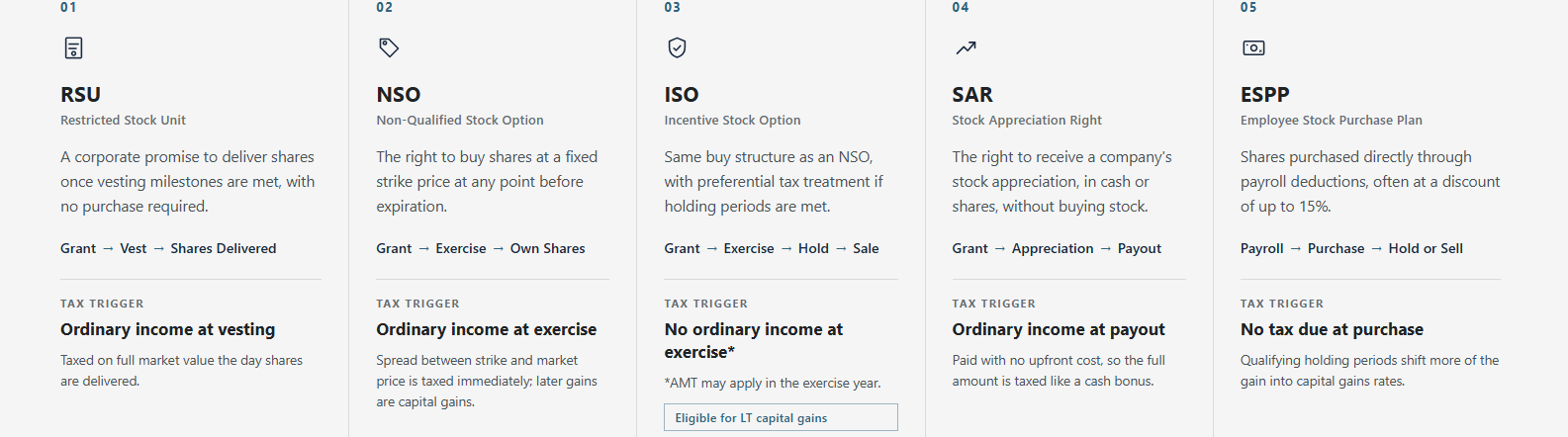
There are five main types of equity grants. Each one works differently and triggers a different tax event at a different time.
RSU (Restricted Stock Unit): Think of an RSU as a corporate promise to deliver company stock once you hit your vesting milestones. You do not pay a dime out of pocket for them, but the IRS treats their full market value as ordinary income on your W-2 the day they vest (like a cash bonus). Because the shares are delivered at vesting, not before, your final payout rises and falls directly with the company's stock price.
Non-Qualified Stock Options (NSOs): Unlike an RSU where you are granted shares, an NSO gives you the right to buy company stock at a fixed strike price (also known as the exercise price) at any time you wish before the expiration date. If the company stock value goes up, you can buy those shares at your lower locked-in strike price and pocket the difference. The catch is that the IRS treats that difference like a cash bonus, taxing the difference as ordinary income the exact day you exercise the options and buy the shares. Any further appreciation in the shares you bought through exercise will be taxed as capital gains.
Incentive Stock Options (ISOs): ISOs offer the same buying structure as NSOs but come with a tax upgrade. Instead of facing an ordinary income tax bill the day you exercise the options and buy the company shares, you pay no tax upfront and can secure lower long-term capital gains rates if certain holding periods are met. The main hurdle is the Alternative Minimum Tax (AMT), which can still trigger an unexpected bill on large exercises in the year following the exercise, making proactive planning incredibly important.
Stock Appreciation Rights (SARs): SARs give you the right to receive a cash payout or shares of stock equal to the appreciation of a company's stock over a specific period. Think of it as a bonus that is tied directly to the company's stock performance, but without you having to actually buy or own the underlying stock up front like with an option. Because you paid nothing upfront, the full payout is treated like a cash bonus and taxed as ordinary income.
ESPP (Employee Stock Purchase Plan): Unlike grants or options, an ESPP lets you buy company stock directly through automatic payroll deductions at a discount of up to 15%. You owe zero taxes when the shares are purchased, and you can choose to sell them immediately or hold them. If you clear the specific holding periods, usually one year from purchase and two years from the offering start, you unlock favorable tax treatment by shifting more of your profit into lower capital gains rates.
Key Pitfalls & Planning Windows to Monitor
Tax treatment differs significantly by grant type, and getting the timing wrong is what usually catches corporate leaders off guard. When managing concentrated equity, several critical blind spots require careful monitoring:
The RSU Underwithholding Gap: Most corporate payroll systems automatically withhold federal tax on vested RSUs at a flat 22% supplemental rate. For high-earning executives whose true marginal tax bracket is 32%, 35%, or 37%, this creates an automatic underwithholding gap that results in a substantial, unexpected tax bill the following April.
The NSO "Paper Wealth" Risk: Exercising NSOs triggers an immediate ordinary income tax bill on the spread, regardless of whether the stock is sold or held. Tying up personal cash to exercise and hold NSOs carries the risk of paying a heavy tax bill on a "paper profit" that could completely evaporate if the company stock drops later.
The ISO Calendar-Year AMT Trap: While ISOs escape regular income tax at exercise, large exercises often trigger the Alternative Minimum Tax (AMT). Holding an unhedged, volatile stock past the December 31 calendar year-end locks in a concrete AMT liability on paper wealth that hasn't actually been cashed out.
SAR Exercise Timing: Because SAR payouts are taxed entirely as ordinary income upon cash-out, timing the exercise is a bracket-management exercise. Strategically timing or spacing out exercises into lower-income years prevents the payout from unnecessarily pushing a professional into the highest federal and state tax brackets.
The ESPP Diversification Dilemma: Employees often struggle with whether to "quick-flip" their ESPP stock for an immediate, guaranteed 15% return or hold it for the required two years to qualify for lower capital gains. Managing this requires balancing the potential tax savings against the structural risk of becoming dangerously over-concentrated in a single company's stock.
What Your Equity Compensation Plan Document Controls
Your equity plan document is not a formality. It controls far more than most executives read before signing.
It sets your vesting schedule, what happens to unvested shares if you leave or are laid off, and how your equity is treated if the company is acquired or there is a change in control. Most people don't look at it until something has already gone wrong.
One rule that catches executives off guard: ISO options must generally be exercised within three months of leaving your job to keep their favorable tax treatment. Miss that window and the ISO benefit is gone.
Read the plan before you need it. The terms are not negotiable after a triggering event, and the difference between acting inside a deadline and missing it can mean the difference between keeping your equity and forfeiting it.
A Concentrated Position Is the Risk No One Warns You About
Most executives with a meaningful equity package end up with a concentrated stock position: the majority of their net worth sitting in one company's shares. It builds quietly, over years of RSU grants that were never sold.
I work with executives in exactly this situation. For example, you can see how we approached this with Sophie, a corporate executive who came to us with years of RSU grants concentrated in a single employer. For many executives like Sophie, the biggest risk isn't a dramatic market crash. The risk is simply inaction, leaving equity on autopilot without a strategy to maximize its value.
A multi-year plan can spread sales and the resulting taxes across several years while gradually reducing single-stock exposure. Managing equity concentration and minimizing our client’s tax bill sits at the center of our wealth management work at GoalVest Advisory.

Key Points for Your Equity Grant Strategy
Ultimately, equity compensation only becomes real wealth when you make active decisions around it. It cannot be left on autopilot. The right move depends entirely on your current cash flow needs, your risk tolerance, and your overall tax bracket.
If you have upcoming vesting dates, unexercised options, or an ESPP window closing, let's map out a strategy for your shares. You can schedule an introductory conversation directly on our calendar below.
____________________________________________________________
About the Author: Sevasti Balafas, CFA, is the founder and CEO of GoalVest Advisory and has more than 20 years of experience in wealth management. She holds an MBA from the Wharton School and is a recurring guest on CNBC and Bloomberg Radio and a contributor to Kiplinger and Barron's.
GoalVest Advisory is a SEC registered investment adviser. Information presented is for educational purposes only intended for a broad audience. The information does not intend to make an offer or solicitation for the sale or purchase of any specific securities, investments, or investment strategies. Investments involve risk and are not guaranteed. GoalVest Advisory has reasonable belief that this marketing does not include any false or material misleading statements or omissions of facts regarding services, investment, or client experience. GoalVest Advisory has reasonable belief that the content as a whole will not cause an untrue or misleading implication regarding the adviser’s services, investments, or client experiences. Please refer to Form ADV Part 2A the adviser’s ADV Part 2A for material risks disclosures. Past performance of specific investment advice should not be relied upon without knowledge of certain circumstances of market events, nature and timing of the investments and relevant constraints of the investment. GoalVest Advisory has presented information in a fair and balanced manner. GoalVest Advisory is not giving tax, legal or accounting advice, consult a professional tax or legal representative if needed.